 Witherbys.com

Posted by Witherbys, INTERCARGO on 3rd Nov 2026
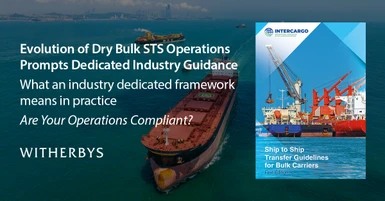
Evolution of Dry Bulk STS Operations Prompts Dedicated Industry Guidance
Over the last decade dry bulk ship-to-ship (STS) has evolved, but without the dedicated guidance infrastructure to support operations. Up until April 2026 guidance for these operations was drawn from the International Maritime Organization’s (IMO) broader safety frameworks, industry guidance adapted from liquid cargo STS best practices and location specific rules. The absence of dedicated guidance has historically been manageable, but now scale is increasing the gap and becoming harder to ignore.
Dry bulk STS operations have become more prevalent for efficiency
The concept of STS provides flexibility and operational efficiency, particularly where port capacity or location constraints present challenges. Reducing the need for port entry is especially helpful for larger ships where these heavily loaded vessels are not always able to be received by ports.
Historically dry bulk STS was mainly utilised for emergency lightering, or in specific circumstances. Increasingly these operations have become more routine, signalling a shift toward how bulk logistics are being increasingly reconfigured offshore.
The shift from occasional to routine dry bulk STS operations has encouraged the specific design for floating infrastructure systems which include the incorporation of floating cranes, transshipment platforms and shuttle vessels. The set up of these systems allows operations to be continuous, particularly in regions such as West Africa, Asia and South America where dry bulk STS is a solution to insufficient land-based infrastructure.
Existing tanker guidance is not transferrable
Tanker STS guidance assumes even load distribution, predictable hull geometry, pump-driven cargo transfer and pollution as the primary risk. Guidance for bulk carriers cannot made on the same assumptions.
Unlike tankers, bulk carriers often have an uneven weight distribution which can result in the hull experiencing bending or overload in areas where mooring lines and fenders apply force. The different positioning of two ships’ fenders, contact points and general structures adds to the complexity of the alignment, in these operations a perfect line up is rare and modifications are made by crewmembers in the absence of specific guidance.
During the transfer of dry bulk cargo cranes or mechanical systems are employed to conduct the transfer between ships. The grab and drop motion can create significant impact force and vibrations throughout the transfer process. These sudden loads can affect mooring lines, create movement between ships and add stress to already loaded areas. By contrast, tankers often utilise a smooth pump system where liquids are transferred continuously and steadily without impact force.
Guidance for tankers is concerned with pollution as the primary risk and while that is also a risk for dry bulk STS, the biggest concern in these operations are the many factors that can create movement problems. Ensuring that bulk carriers remain stable and structurally safe throughout the transfer process are where guidelines should prioritise long-term safety and resilience.
The operational and liability risks that the guidance gap has introduced
When operations are not standardised unnecessary inconsistency and variability in outcomes is introduced, along with the exposure to inefficiencies, compliance gaps and reduced confidence. Due to the absence of specific guidance for dry bulk STS, the current operations are not informed by a fit-for-purpose checklist, leaving the gap wide open for operational risks including:
- Improvisation of operations or procedures varying between contractors and regions
- Informal communication protocols between vessels
- Introduction of specific dry bulk STS equipment risks such as load swings, impact damage and structural stress
- Stability issues where weight shifts and force issues are observed
Because of these varying risks and significant difference across operations, the ‘best practice’ of dry bulk STS is less defined and often up for debate, resulting in unclear standards of care and inconsistent contracts. Without uniform standards across the industry, different ports and states can impose different rules and enforcements. This becomes increasingly difficult when navigating negligence claims from a legal point standpoint due to the uncertainty and unclear benchmarks, it can also make legal outcomes of the same operation differ per region.
What an industry dedicated framework means in practice
The new dry bulk STS specific guidelines from INTERCARGO serve as the industry’s catalyst for supporting safe and efficient operations. Masters and operators are provided with a standardised operating model that improves consistency and aims to ensure that every transfer is performed within the defined safety, compliance and contractual measures.
With a formalised process all crewmembers involved will benefit from defined authority, roles and communication protocols. The guidelines force prior planning meaning proactive decision making will take over from reactive, improvised approaches, progressing the industry into a new phase of structure.
Now dry bulk STS operations will be guided by comprehensive guidance that serves as a crucial reference for not just compliance, but the safety of both vessel and crew.
References:
Ship to Ship Transfer Guidelines for Bulk Carriers - First Edition
https://safety4sea.com/intercargo-issues-call-for-safe-sts-transfers-framework-in-dry-bulk-shipping/
https://dbce.org/managing-change-and-risk-in-dry-bulk-shipping-lessons-from-drybms-safety-framework/