 Witherbys.com


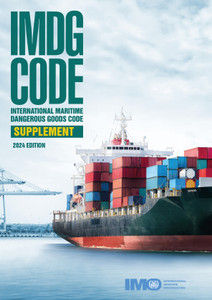
IMDG Code (Amendment 43-26), 2026 Edition
$277.85
The International Maritime Dangerous Goods Code (IMDG Code) lays out the regulatory framework for all aspects of handling dangerous goods and marine pollutants in sea transport.
The IMDG Code is divided into two volumes:
• Volume 1 containing sections on general provisions, definitions and training; classification; packing and tank provisions; consignment procedures; construction and testing of packagings, IBCs, large packagings, portable tanks, MEGCs and road tank vehicles and transport operations; and
• Volume 2 containing the Dangerous Goods List, special provisions and exceptions, Appendix A (list of generic and N.O.S. proper shipping names), Appendix B (glossary of terms) and the Index.
Since it was first published in 1965, the Code has undergone many changes, in both format and content, in order to keep up with the rapid expansion of the shipping industry.
Amendment 43-26 includes updates to the provisions for the carriage of batteries and clearer criteria for the transport of vehicles, including electric vehicles. It also introduces new special provisions for vehicle safety assessment (SP 980), revisions to existing special provisions SP 961 and SP 962, new UN entries for lithium and sodium-ion battery systems, updates to segregation distances for radioactive cargo, and consequential amendments to the EmS Guide. It was adopted by the International Maritime Organization’s Maritime Safety Committee at its one hundred and eleventh session in May 2026 and is mandatory from 1 January 2028 but may be applied by Administrations in whole or in part on a voluntary basis from 1 January 2027.
The provisions of the Code should be of interest to maritime administrations, shipping companies, manufacturers, packers, shippers, feeder services such as road and rail, and port authorities.
Foreword
Preamble
PART 1 GENERAL PROVISIONS, DEFINITIONS AND TRAINING
Chapter 1.1: General provisions
Chapter 1.2: Definitions, units of measurement and abbreviations
Chapter 1.3: Training
Chapter 1.4: Security provisions
Chapter 1.5: General provisions concerning radioactive material
PART 2 CLASSIFICATION
Chapter 2.0: Introduction
Chapter 2.1: Class 1 – Explosives
Chapter 2.2: Class 2 – Gases
Chapter 2.3: Class 3 – Flammable liquids
Chapter 2.4: Class 4 – Flammable solids; substances liable to spontaneous combustion; substances which, in contact with water, emit flammable gases
Chapter 2.5: Class 5 – Oxidizing substances and organic peroxides
Chapter 2.6: Class 6 – Toxic and infectious substances
Chapter 2.7: Class 7 – Radioactive material
Chapter 2.8: Class 8 – Corrosive substances
Chapter 2.9: Miscellaneous dangerous substances and articles (class 9) and environmentally hazardous substances
Chapter 2.10: Marine pollutants
PART 3 DANGEROUS GOODS LIST, SPECIAL PROVISIONS AND EXCEPTIONS
Note
Chapter 3.1: General
Chapter 3.2: Dangerous Goods List
Chapter 3.3: Special provisions applicable to certain substances, materials or articles
Chapter 3.4: Dangerous goods packed in limited quantities
Chapter 3.5: Dangerous goods packed in excepted quantities
PART 4 PACKING AND TANK PROVISIONS
Chapter 4.1: Use of packagings, including intermediate bulk containers (IBCs) and large packagings
Chapter 4.2: Use of portable tanks and multiple-element gas containers (MEGCs)
Chapter 4.3: Use of bulk containers
PART 5 CONSIGNMENT PROCEDURES
Chapter 5.1: General provisions
Chapter 5.2: Marking and labelling of packages including IBCs
Chapter 5.3: Placarding and marking of cargo transport units and bulk containers
Chapter 5.4: Documentation
Chapter 5.5: Special provisions
PART 6 CONSTRUCTION AND TESTING OF PACKAGINGS, INTERMEDIATE BULK CONTAINERS (IBCs), LARGE PACKAGINGS, PORTABLE TANKS, MULTIPLE-ELEMENT GAS CONTAINERS (MEGCs) AND ROAD TANK VEHICLES
Chapter 6.1: Provisions for the construction and testing of packagings
Chapter 6.2: Provisions for the construction and testing of pressure receptacles, aerosol dispensers, small receptacles containing gas (gas cartridges) and fuel cell cartridges containing liquefied flammable gas
Chapter 6.3: Provisions for the construction and testing of packagings for class 6.2 infectious substances of category A (UN 2814 and UN 2900)
Chapter 6.4: Provisions for the construction, testing and approval of packages for radioactive material and for the approval of such material
Chapter 6.5: Provisions for the construction and testing of intermediate bulk containers (IBCs)
Chapter 6.6: Provisions for the construction and testing of large packagings
Chapter 6.7: Provisions for the design, construction, inspection and testing of portable tanks and multiple-element gas containers (MEGCs)
Chapter 6.8: Provisions for road tank vehicles and road gas elements vehicles
Chapter 6.9: Provisions for the design, construction, inspection and testing of bulk containers
Chapter 6.10: Provisions for the design, construction, inspection and testing of portable tanks with shells made of fibre-reinforced plastics (FRP) materials
PART 7 PROVISIONS CONCERNING TRANSPORT OPERATIONS
Chapter 7.1: General stowage provisions
Chapter 7.2: General segregation provisions
Chapter 7.3: Consigning operations concerning the packing and use of cargo transport units (CTUs) and related provisions
Chapter 7.4: Stowage and segregation on containerships
Chapter 7.5: Stowage and segregation on ro-ro ships
Chapter 7.6: Stowage and segregation on general cargo ships
Chapter 7.7: Shipborne barges on barge-carrying ships
Chapter 7.8: Special requirements in the event of an incident and fire precautions involving dangerous goods
Chapter 7.9: Exemptions, approvals and certificates
APPENDICES
Appendix A: List of generic and N.O.S. proper shipping names
Appendix B: Glossary of terms
Index
Index
IMO
As a specialised agency of the United Nations, the International Maritime Organization (IMO) is the global standard-setting authority for the safety, security and environmental performance of international shipping. Its main role is to create a regulatory framework for the shipping industry that is fair and effective, universally adopted and universally implemented.
In other words, its role is to create a level playing field so that ship operators cannot address their financial issues by simply cutting corners and compromising on safety, security and environmental performance. This approach also encourages innovation and efficiency.
Shipping is a truly international industry, and it can only operate effectively if the regulations and standards are themselves agreed, adopted and implemented on an international basis. And IMO is the forum at which this process takes place.
- Number of Pages:
- 961
- Book Height:
- 315 mm
- Book Width:
- 220 mm
- Weight:
- 2.01 kg
- Author:
IMO
- IMO Code (Physical Book):
- IP200E
- Publication Date (Physical Book):
- October 2026
- IMO Code (Witherby Connect):
- KP200E
- Publication Date (Witherby Connect):
- September 2026
- Published Date:
- October 2026