 Witherbys.com


Biofouling, Biosecurity and Hull Cleaning - 3rd Edition, 2027-28
$231.96
This fully illustrated publication describes in detail the problems that biofouling can cause to ship operations and the marine environment. It examines the use of anti-fouling systems to prevent the build-up of biofouling as well as the options available for ship cleaning, in particular the importance of in-water cleaning. It also sets out the revised 2023 IMO Biofouling Guidelines, specific regional mandatory biofouling requirements and the mandatory IMO AFS Convention. This edition includes a fully updated section of informative data sheets with for a number of in-water hull cleaning companies worldwide.
The build-up of biofouling can have a significant impact on ship hydrodynamics and energy efficiency as well as interfere with efficient operation of internal seawater systems. It can also threaten the marine environment through the transfer and establishment of non-native invasive species, or through the use of anti-fouling systems containing certain toxic substances.
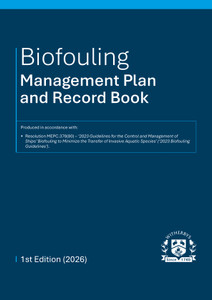
The publication sets out current biofouling legislative requirements, including the IMO 2023 Biofouling Guidelines and its importance in the current development of mandatory measures for the control and management of biofouling, updates to the International Convention on the Control of Harmful Anti-fouling Systems on Ships (AFS Convention), and individual national and regional biofouling legislation. It provides templates for the Biofouling Management Plan and the Biofouling Record Book from the 2023 Biofouling Guidelines.
This publication identifies ship structures that are vulnerable to biofouling, factors affecting the rate of build-up and the effect of biofouling on ship performance and operating costs. It looks in detail at biofouling management, including the use of biocidal and non-biocidal paints and coatings, corrosion, marine growth prevention systems, and both in-water and dry dock cleaning. It briefly discusses the importance of environmental research initiatives into the effects of biofouling.
This book has a completely new Ship Biosecurity section for pests that are not transported as biofouling on the wetted surfaces of a ship but can still represent a significant biosecurity threat in certain regions. There is key information on the seasonality, local regulations and reporting requirements, as well as methods of control and management of the Flighted Spongy Moth Complex and the Brown Marmorated Stink Bug.
Finally, this new edition provides an updated selection of data sheets summarising the services offered and area of operation of hull cleaning and inspection companies worldwide. This section includes world maps to enable readers to quickly identify companies operating in particular geographic locations.
Contents
Acknowledgements
Part 1 Background
Chapter 1 Background
1.1 What is Biofouling?
1.2 The Establishment of Biofouling
1.3 Corrosion
1.3.1 Microbiologically Influenced Corrosion (MIC)
1.4 Cathodic Protection (CP)
1.4.1 Sacrificial anode cathodic protection (SACP)
1.4.2 Impressed current cathodic protection (ICCP)
1.4.3 Marine Growth Protection System
1.5 Invasive Species
Part 2 Biofouling Legislation and Guidelines
Chapter 2 The 2023 Biofouling Guidelines
2.1 The 2023 ‘Guidelines for the Control and Management of Ships’ Biofouling To Minimize the Transfer of Invasive Aquatic Species’ (2023 Biofouling Guidelines)
2.2 Design and Construction
2.3 Anti-fouling Systems (AFS)
2.4 Niche Areas
2.5 In-water Operations: Inspection, Cleaning and Maintenance
2.5.1 In-water Inspection
2.5.2 In-water Cleaning and Maintenance
2.6 The Biofouling Management Plan and Record Book
2.6.1 The Biofouling Management Plan (BFMP)
2.6.2 The Biofouling Record Book (BFRB)
2.6.3 Training and Education
Chapter 3 Regulations for the Control of Anti-fouling Systems (AFS)
3.1 The International Convention on the Control of Harmful Anti-fouling Systems on Ships (AFS Convention)
Chapter 4 National and Regional Biofouling Requirements
4.1 Australia
4.1.1 The Australia ‘Biosecurity Act 2015’
4.1.2 The ‘Australian anti-fouling and in-water cleaning guidelines’ (2024)
4.2 New Zealand
4.2.1 The ‘Craft Risk Management Standard (CRMS) for Vessels (2023)’
4.2.2 Places of First Arrival (PoFA)
4.2.3 Specific Requirements (Short-Stay, Long-Stay and Cruise)
4.2.4 Pre-Arrival Documentation/Information
4.2.5 Biofouling Inspections
4.2.6 Non-compliance and Penalties
4.3 United States of America
4.3.1 Federal Law
4.4 Individual US State Biofouling Requirements
4.4.1 California
4.4.2 Hawaii
4.4.3 Maine
4.4.4 Washington
4.5 Polar Waters
4.6 Belgium
4.7 United Kingdom
4.8 Norway
4.8.1 The Best Available Technology
4.8.2 Exemptions
4.9 Brazil
4.9.1 The Port of Santos
4.10 Further National and Regional Fouling Management Requirements
4.11 Ships Affected by National Regulations
Part 3 Biofouling and the Ship
Chapter 5 Ship as a Carrier
5.1 Biofouling Assessment
5.2 Areas of Attachment on a Ship
5.3 Newbuild Design to Minimise Biofouling
5.4 Operational Profile and Maintenance of the Ship/Marine Structure
5.4.1 Type of Ship and its Charter Profile
5.4.2 Operating in Different Environments
5.5 Marine Structures/Devices
Chapter 6 Biofouling and Ship Performance
6.1 Effect of Biofouling on Ship Hydrodynamics and Energy Efficiency
6.1.1 IMO Measures and Guidance for Energy Efficiency
6.1.2 ISO Standards
6.2 Biofouling Cost Effects
Chapter 7 Biofouling, Biosecurity and Research
7.1 The Effects of Biofouling on the Marine Environment
7.1.1 The Effects of Biofouling Control and Removal
7.2 Environmental Research Initiatives
7.2.1 The GloFouling Partnership Project
7.2.2 The TEST Biofouling Project
Part 4 Biofouling Management
Chapter 8 Anti-fouling Systems (AFS)
8.1 Biocidal Paints and Coatings
8.1.1 Ablative or Soluble Matrix Coatings
8.1.2 Contact Leaching
8.1.3 Self-polishing Copolymer (SPC)
8.2 Non-biocidal and Hybrid AFS
8.2.1 Foul Release Coatings (FRC)
8.2.2 Hard Inert Coatings
8.3 Marine Growth Prevention Systems (MGPS)
8.3.1 Anodic Copper Systems
8.3.2 Aluminium and Iron Anodes
8.3.3 Electrochlorination
8.3.4 Direct Chemical Dosing
8.3.5 Ultrasound
8.3.6 MGPS Maintenance
8.3.7 Periods of Ship Inactivity
8.4 Selecting an AFS/AFC
8.5 Application of AFS/AFC
8.5.1 Applying AFS/AFC to Specific Niche Areas
8.5.2 Proper Application of AFC
Chapter 9 Ship Cleaning
9.1 In-water Cleaning
9.1.1 Brush Systems
9.1.2 Soft Tools
9.1.3 Water Jet and Air Jet (Blast) Systems
9.1.4 AFS Resistance to Cleaning
9.1.5 Propeller Cleaning
9.1.6 Proactive In-water Cleaning
9.1.7 The Future of In-water Hull Cleaning (IWHC)
9.2 Cleaning/Maintenance in Dry Dock
9.2.1 Dry-docking Planning Considerations
9.2.2 Hydroblasting
9.2.3 Abrasive Blasting
9.3 Hull Cleaning and Ship Operations
Part 5 Ship Biosecurity
Chapter 10 Flighted Spongy Moth Complex (FSMC)
10.1 Biosecurity Concerns
10.2 FSMC Seasonality and Local Regulations
10.2.1 Argentina
10.2.2 Australia
10.2.3 Chile
10.2.4 New Zealand
10.2.5 United States and Canada
10.3 Transportation by the Ship
10.3.1 How to Deal with Infestations on Board
10.3.2 Pre-arrival Self Inspection
10.3.3 Obligations and Responsibilities
Chapter 11 Brown Marmorated Stink Bug (BMSB)
11.1 Introduction
11.1.1 Characteristics of an Invasive Species
11.2 Seasonality and Regional Requirements
11.2.1 Australia
11.2.2 New Zealand
11.2.3 Chile and Fiji
Appendices
Appendix 1 Example Form of Biofouling Management Plan (from Appendix 3 in the 2023 Biofouling Guidelines)
Appendix 2 Example Form of Biofouling Record Book (from Appendix 4 in the 2023 Biofouling Guidelines)
Appendix 3 Data Sheets for Hull Cleaning Companies
Appendix 4 Ship Wetted Surface Area (WSA) Information
Witherbys
Witherbys titles are developed using scripts developed by technical experts that are peer reviewed within work groups. Typically, they seek to improve understanding of the regulations, recommendations and guidelines issued by Industry.
Witherbys staff have significant expertise in the fields of navigation and hazardous cargoes as well as in the presentation of complex subjects in a graphic and easy to understand manner.
BIMCO
Facilitating trade is at the very heart of our business, and since 1905, we've helped our members keep world trade moving. We make it our business to help our members with theirs.
BIMCO members cover 64% of the world's tonnage and consist of local, global, small and large companies. We are an organisation and global shipping community of 2,100 members in 120 countries.
From our offices in Athens, Brussels, Copenhagen, Houston, London, Shanghai and Singapore we aim to help build a resilient industry in a sustainable future whilst protecting world trade. We do this by finding practical solutions for our members to help them manage risk in a changing world.
To find out more, please visit About BIMCO.
ICS
The International Chamber of Shipping (ICS) is the global trade association representing national shipowners' associations from Asia, Africa, the Americas and Europe and more than 80% of the world merchant fleet. Established in 1921, ICS is concerned with all aspects of maritime affairs particularly maritime safety, environmental protection, maritime law and employment affairs. ICS enjoys consultative status with the UN International Maritime Organization (IMO) and International Labour Organization (ILO).
ICS also develops best practices and guidance, including a wide range of publications and free resources that are used by ship operators globally.
- Number of Pages:
- 242
- ISBN (Physical Book):
- 978-1-918766-35-6
- Publication Date (Physical Book):
- November 2026
- ISBN (Witherby Connect):
- 978-1-918766-36-3
- Book Height:
- 220 mm
- Book Width:
- 305 mm
- Weight:
- 1.4 kg
- Author:
Witherbys, BIMCO and International Chamber of Shipping