 Witherbys.com

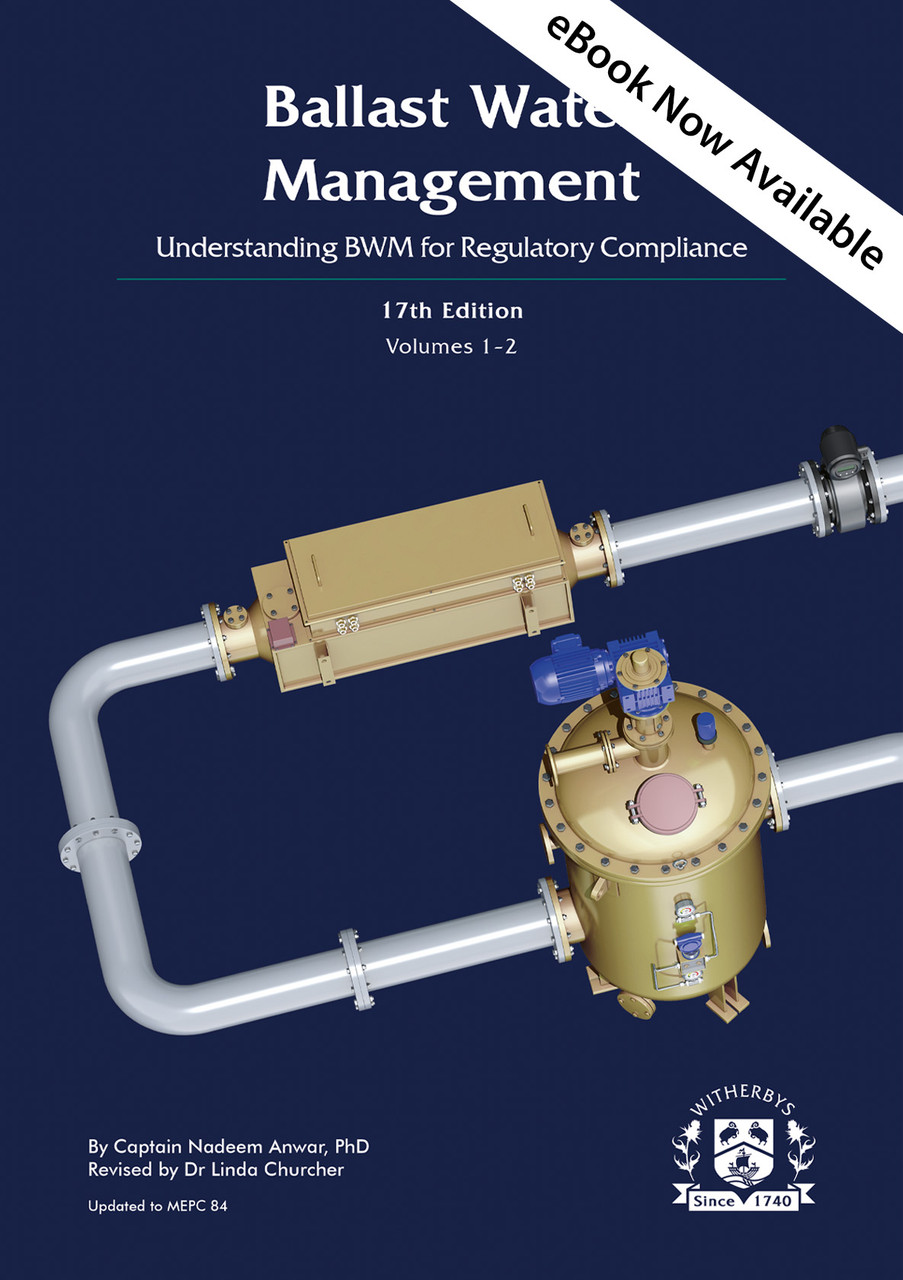
Ballast Water Management, Understanding BWM for Regulatory Compliance, 17th Edition, Volumes 1-2
$525.63
The 17th edition has been fully revised to reflect current requirements in the management of ballast water since the International Convention for the Control and Management of Ships' Ballast Water and Sediments (BWM Convention) entered into force.
To assist ship owners with BWM Convention compliance, the book is divided into two useful volumes: Volume 1 - Regulations, Operations and Compliance and Volume 2 - BWM Systems. As well as regulatory guidance, Volume 1 includes valuable practical considerations relating to Ballast Water Management System (BWMS) selection, installation/retrofitting, onboard operation (including dealing with challenging water quality), maintenance, monitoring and reporting. Volume 2 is a thorough compilation of standardised information for BWMS that have been type approved for use on board ships.
Since 8th September 2024, all ships to which the BWM Convention applies have had to comply with the Convention's ballast water discharge standard (D-2). For most ships, this has involved installing and operating a BWMS on board. This comprehensive, two-volume publication provides up-to-date guidance on BWM regulations, operations (including Port State Control (PSC) requirements) and equipment options. It is a valuable, single-point source of information for ship owners and operators.
In Volume 1, the publication looks in detail at the various treatment systems and technologies, significant components and the implications for onboard operation, maintenance and contingency measures. With the end of the implementation period for fitting a BWMS to existing ships, there is a shift from retrofitting to installing on newbuilds, replacement retrofits and fulfilling maintenance/servicing agreements. However, retrofit experience remains an important consideration as there will also be a growing market for fully or partly replacing older (legacy) BWMS or systems that are not operating properly.
The BWM Convention has been fully in effect for seven years, and the experience-building phase (EBP) is expected to continue until the entry into force of the package of priority amendments, which is likely to be in autumn 2028. PSC have also increased inspections to promote consistent implementation of the BWM Convention requirements. The preliminary results of a concentrated inspection campaign (CIC) in 2025 by several PSC memoranda of understanding (MoU) found that one of the main deficiencies was in the operability of the BWMS on board the inspected ships. This emphasises that proper maintenance of the BWMS is a key factor in compliance with the Convention.
The EBP was designed to allow the MEPC to monitor implementation of the BWM Convention over time and highlight areas that need further attention. The BWM Convention is undergoing a thorough review, which is well underway, with many amendments already agreed upon. This includes a comprehensive update to the Guidelines for ballast water management and development of ballast water management plans (G4)
Volume 2 provides an extensive set of data sheets on BWMS that have been type approved through the BWM Convention testing procedures. These summarise the treatment technology, type approval certification and system design limitations (SDL), so that ship owners can evaluate different systems and make an informed decision before purchasing. It is particularly important to know the SDL of a BWMS since these are the conditions and parameters under which the system is approved to operate.
The Appendices contain an updated list of IMO Guidance Documents for the BWM Convention (updated to MEPC 83). They also describe key invasive species and illustrate native and invasive geographic ranges.
The discharge of untreated ballast water (BW) has been a key factor in the transfer of non-indigenous aquatic species that have subsequently established and become pests in various parts of the world. The economic and environmental damage these invasive species can cause has been well documented and the importance of managing untreated BW on board ships cannot be overstated.
National and international requirements to control the spread of non-indigenous aquatic species through the management of BW by ballast water exchange (BWE) have been in effect in most regions and ports for many years. The International Convention for the Control and Management of Ships’ Ballast Water and Sediments (BWM Convention) entered into force on 8th September 2017. As at August 2026, there were 102 contracting States to the BWM Convention, representing approximately 93.48% of the world’s merchant shipping tonnage.
The BWM Convention has been fully in effect for seven years. Between 8th September 2019 and 8th September 2024, all existing ships to which the Convention applies had to become compliant with the D-2 standard by the renewal date of the ship’s next International Oil Pollution Prevention (IOPP) Certificate.
The experience-building phase (EBP) of the Convention began on entry into force (EIF) of the BWM Convention and ends with EIF of the package of priority amendments, which is likely to be in the autumn of 2028. The EBP regime was designed to allow the MEPC to monitor the implementation of the BWM Convention over time and highlight areas that need further attention. The BWM Convention is undergoing a thorough review, which is well underway, with many amendments already agreed upon. This includes a comprehensive update to the Guidelines for ballast water management and development of ballast water management plans (G4). During the EBP there has been a grace period where, under specific circumstances, ships could not be penalisation for the discharge of non-compliant BW. This grace period will end when the EBP ends, however, penalties can still be issued for failures in other areas of BWM.
Port State Control (PSC) have also increased inspections to promote consistent implementation of the BWM Convention requirements. The preliminary results of a concentrated inspection campaign (CIC) in 2025 by several PSC memoranda of understanding (MoU) found that one of the main deficiencies was in the operability of the BWMS on board the inspected ships. This emphasises that proper maintenance of the BWMS is a key factor in compliance with the Convention.
Now that the BWM Convention implementation period has passed, the emphasis is on new build installations, replacement retrofits and fulfilling maintenance/servicing agreements. BWMS suppliers will have to retain the expertise to retrofit BWMS however, these installations may be more straightforward as they will be on ships that have already had a BWMS fitted on board. As the pressure for ships’ regulatory compliance increases, the replacement of existing/legacy BWMS with more efficient, suitable and reliable systems will be an important part of business. For a ship owner/operator, choosing a system supplier that is able to provide comprehensive and reliable servicing to a BWMS that has been retrofitted, or installed on board a new build, is now a very important consideration.
Foreword
Abbreviations
Volume One - Guidance
Part One - Introduction and Regulations
Chapter One - Introduction
1.1 Ballast Water
1.2 Sediment
1.3 Aquatic Species
1.4 Ballast Tank Configuration
1.5 Biofouling
Chapter Two - IMO Regulations
2.1 BWM Convention - Section A
2.2 BWM Convention - Section B
2.3 BWM Convention - Section C
2.4 BWM Convention - Section D
2.5 BWM Convention - Section E
2.6 The IMO BWMS Approval Process
2.7 Key Updates to the BWM Convention
Chapter Three - Local and Regional Regulations
3.1 Americas
3.2 United Kingdom
3.3 Polar Waters
Chapter Four - Alternatives to Using a BWMS On Board
4.1 Port Reception Facilities
4.2 Contingency Measures
4.3 Port-based Ballast Water Treatment
4.4 Sediment Control
Part Two - Implementation of Regulations
Chapter Five - Port State Authorities and Port State Control
5.1 Port State Requirements
5.2 Existing Conditions
5.3 Notification
5.4 Inspection, Monitoring and Enforcement
Chapter Six - The Financial Implications of BWM Legislation
6.1 Cost of Compliance with BWM Legislation
6.2 Cost of Ballast Water Management Systems (BWMS)
6.3 Issues and Costs for BWMS Manufacturers
6.4 Cost of Ballast Water Exchange (BWE)
Part Three - Treatment Systems and Operation
Chapter Seven - Introduction to Treatment Technologies
7.1 Ballast Water Management System (BWMS) Requirements
7.2 The Evolution of BWMS
Chapter Eight - Physical Separation, Thermal, Ultraviolet and Plasma Technologies
8.1 Physical Separation
8.2 Heat Treatment Technology
8.3 Ultraviolet Radiation/Advanced Oxidation Technology
8.4 Plasma Technology
Chapter Nine - Deoxygenation, Magnetic and Ultrasonic/Cavitation Technologies
9.1 Deoxygenation/Supersaturation Technology
9.2 Magnetic/Electric Field Technology
9.3 Ultrasonic and Hydrodynamic Cavitation Technology
Chapter Ten - Chemical, Biocide and Electrochemical Technologies
10.1 Chemical and Biocide Technology
10.2 Electrochemical Technology
Part Four - Practical Installation and Retrofitting Considerations
Chapter Eleven - Choosing a BWMS
11.1 Making the Decision
Chapter Twelve - The Design Stage (Feasibility Study and 3D Scan)
12.1 Retrofit Planning
12.2 Retrofitting - Feasibility Study
12.3 The 3D Scan
12.4 The Design Engineering Stage
12.5 The Role of Class
12.6 Selection of Retrofit Location
Chapter Thirteen - The Installation Process
13.1 Simplified Overview
13.2 Detailed Overview
13.3 Before Entering the Retrofit Facility
13.4 During the Stay in the Retrofit Facility
13.5 Departing the Retrofit Facility/Dry Dock
13.6 Technical Installation and Retrofit Facility/Dry Dock Challenges
Chapter Fourteen - Commissioning of the BWMS
14.1 Delays in the Commissioning Process
14.2 IMO Commissioning Guidance
Part Five - Operations
Chapter Fifteen - Ship Administration of BWM
15.1 The Ballast Water Management Plan (BWMP)
15.2 Ballast Water Record Book (BWRB)
15.3 Surveys
15.4 Certification
15.5 Ballast Water Reporting
15.6 Training
Chapter Sixteen - Ballast Water Sampling/Monitoring
16.1 Monitoring of Operations
16.2 Arrival Ballast Conditions
16.3 Monitoring Levels
16.4 Post-treatment Monitoring
16.5 Sampling
16.6 Sediment
16.7 Test Methods
16.8 Ballast Tank Entry
Chapter Seventeen - Maintenance and Operational Issues
17.1 Maintenance Issues
17.2 Operational Issues
17.3 Emergency/Contingency Measures
Chapter Eighteen - Preparing for Inspections
18.1 Overview of PSC Inspections
18.2 Checklist for Preparing for Inspections
18.3 Reducing Overall Risk
18.4 Ship Inspection Report Programme (SIRE) and Other Inspection Regimes
Chapter Nineteen - Challenging Water Quality (CWQ)
19.1 Regulatory Guidance
19.2 Operations
19.3 Assessing BWMS Operations
19.4 Troubleshooting and Mitigation
19.5 Alternatives to Bypass
19.6 Bypass Procedure
19.7 Decontamination
19.8 Records and Roles
Chapter Twenty - Ballast Water Exchange (BWE)
20.1 BWE Operational Considerations
20.2 Sequential BWE Method
20.3 Flow-through BWE Method
20.4 BWE Operations Checklists
Appendices
A1 Key Invasive Species
A2 IMO Guidance Documents for the BWM Convention
Dr Captain Nadeem Anwar
Master Mariner, FNI, SFHEA, ACII, DoS, PGCEL, MSc (Maritime Operations), BSc (Quality Management), CertEd.
Having completed pre-sea training in 1983, Captain Anwar sailed on a variety of ship types, including VLCCs, OBOs, O/Os, gas and chemical tankers. His time at sea was mainly spent in deep-sea trade, which gave him a wide-ranging experience of navigating in different areas of the world. He left sea while in command in 1998.
In education since 1998, he is now Senior Lecturer in the Petrochemical section at Warsash Academy and Leader for MSc Shipping Operations (online).
- Number of Pages:
- 420
- Weight:
- 2.5 kg
- Author:
Captain Nadeem Anwar, PhD
- Publication Date (Physical Book):
- November 2026
- ISBN (Physical Book):
- 9781918766301
- Physical:
- (Available to preorder - stock due November)
- Book Height:
- 150 mm
- Book Width:
- 210 mm