 Witherbys.com


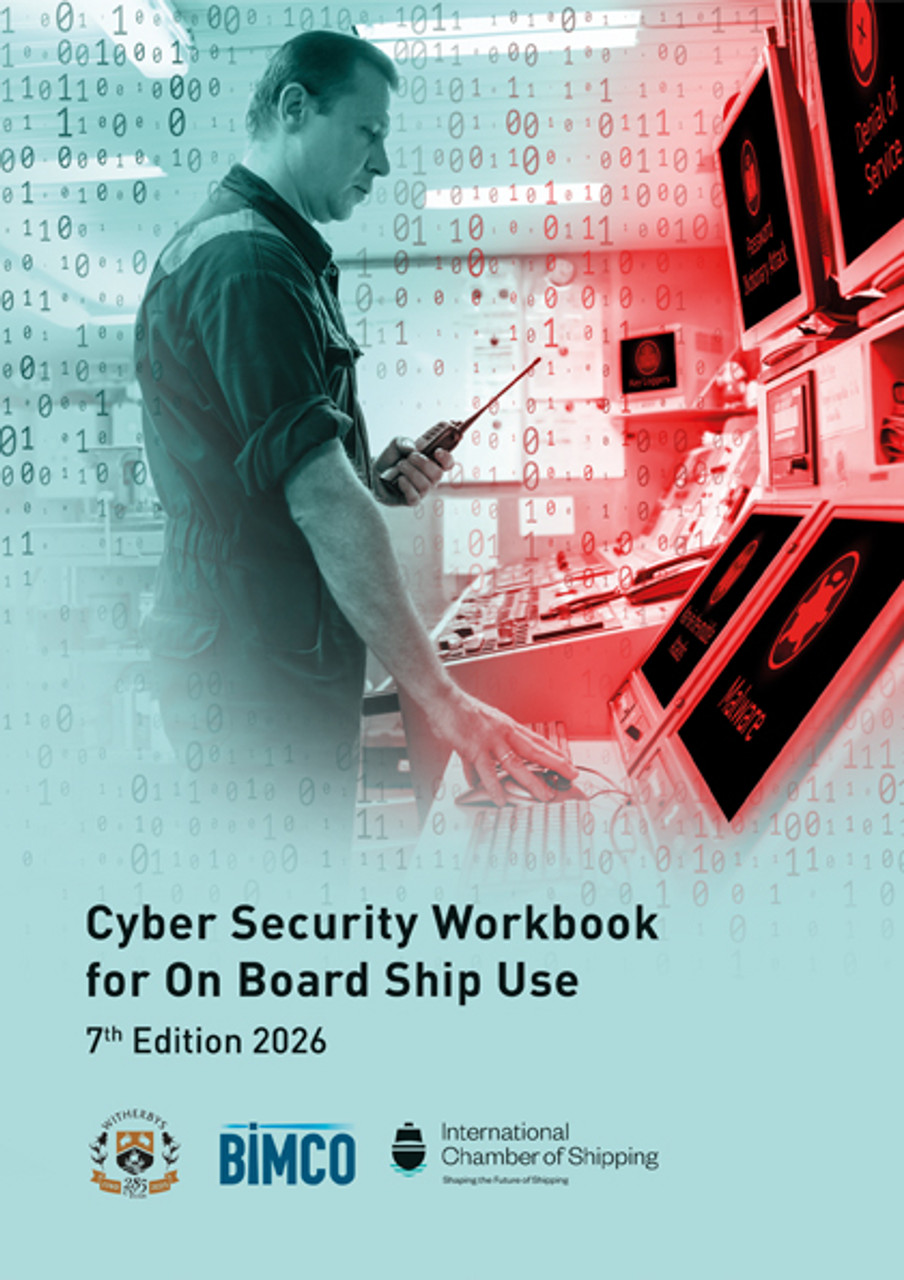
This practical and easy to understand workbook supports the owner, Master and the ship's crew with cyber security risk management.
It contains comprehensive checklists to support the day-to-day management of onboard cyber security and facilitates collaboration between ships, onshore IT departments and equipment manufacturers.
Cyber risk management should be an inherent part of safety and security and should be considered at all levels of the company, including senior management ashore and onboard personnel.
This Workbook has been designed as a practical, straightforward guide to support the Master and officers on board ship (Part I – Onboard Practical Considerations). It is designed to facilitate understanding and good collaboration between individual ships, onshore IT departments and equipment manufacturers (Part II – Shore Management Considerations).
The Workbook may also be useful to the wider maritime industry.
The 7th Edition has been produced by Witherbys, BIMCO and the International Chamber of Shipping (ICS).
The Workbook has been fully revised and updated and contains new guidance on:
- Industry guidelines and regulatory requirements, including IACS UR E26 and E27
- cyber security in port
- passenger ships
- ship inspections and port state control
- software updates
- malware detection and prevention
- phishing risks.
Detailed case studies and diagrams have been added to help illustrate cyber risks. The Workbook contains 13 Checklists and 6 Annexes, including Cyber Security Risk Assessment and Creating a Cyber Security Plan.
Foreword
Abbreviations/Definitions
Introduction
Section 1 – Regulations and Guidance
1.1 IMO Requirements
1.2 'The Guidelines on Cyber Security Onboard Ships'
1.3 Additional Industry Guidelines
1.4 Regional Regulatory Guidance
1.5 Guidance on Mitigation Strategies for IT
Part One – Onboard Practical Considerations
Section 2 – Identifying Risks
2.1 Vulnerable Ship Systems
2.2 What is a Maritime Cyber Attack?
2.3 Phases of a Cyber Attack
2.4 Threats
2.5 Types of Cyber Attack
2.6 Social Engineering
2.7 Ransomware
2.8 Use of Artificial Intelligence
Section 3 – Protection and Prevention: General Principles
3.1 Prevention of Malware Attacks
3.2 Software Updates
3.3 Endpoint Protection/Security Suite
3.4 Passwords
3.5 Cyber Security and the Safety Management System (SMS)
3.6 Ship Inspections and Port State Control (PSC)
Section 4 – Crew Considerations and Training
4.1 Key Aspects of Crew Training
4.2 Cyber Security Familiarisation for Crew
4.3 Training for Non-crewmembers
4.4 Designing a Training Programme
4.5 Unintentional Cyber Breaches by the Crew
4.6 Planning a Crew Training Session
4.7 Cyber Security Drills
4.8 Social Media
4.9 Travelling in Cyber Safe Mode
Section 5 – Detect, Respond and Recover: General Principles
5.1 Detecting a Cyber Incident
5.2 Incident Response
Section 6 – External Communications and Cyber Security in Port
6.1 Satellite Communications (Satcom) Equipment
6.2 Cyber Security Risks in Port
Section 7 – Ship's Business Systems
7.1 Network Segregation On Board
7.2 Wireless Networks On Board
7.3 Onboard Business Computers
7.4 Passenger Ship Systems
Section 8 – OT Systems
8.1 Understanding OT Systems
8.2 Engine Department Considerations
8.3 Cargo Management
8.4 ECDIS Security
8.5 GNSS Security
8.6 Other Bridge Systems
Part Two – Shore Management Considerations
Section 9 – Key Considerations
9.1 Cooperation Between the Office Departments and their Suppliers
9.2 Cooperation Between the Office and the Ship's Crew
9.3 Ship's Network Architecture
Section 10 – OT Systems Management
10.1 OT Asset Management and Risk Assessment
10.2 Securing OT Systems
10.3 Securing the Ethernet IP Network Used by OT Systems
10.4 Intrusion Detection Systems (IDS)
Section 11 – IT Systems Management
11.1 Remote Access
11.2 Vulnerability Scanning (Cyber Audit)
11.3 Penetration (Pen) Testing
11.4 Endpoint Detection and Response (EDR)
11.5 Disaster Recovery from Backup
11.6 Uninterruptible Power Supply (UPS) for IT/OT Systems
Checklists
Checklist 1 - Cyber Security Familiarisation for New Crewmembers
Checklist 2 - Cyber Security Crew Training
Checklist 3 - Detecting a Cyber Incident
Checklist 4 - Responding to a Cyber Incident On Board
Checklist 5 - Onboard Business Computer
Checklist 6 - Network Segregation
Checklist 7 - Networks (Wireless and Wired)
Checklist 8 - Satellite Communications
Checklist 9 - OT Systems Initial Inspection
Checklist 10 - ECDIS Cyber Security
Checklist 11 - Cyber Security Checks on the Navigation Bridge
Checklist 12 - Asset Management and Risk Assessment
Checklist 13 - Remote Access
Annexes
Annex 1 - Cyber Security Assessment
Annex 2 - Creating a Cyber Security Plan
Annex 3 - Creating User Accounts
Annex 4 - Checking for Segregated Networks
Annex 5 - NMEA 0183
Annex 6 - Further Resources
BIMCO
BIMCO is the world's largest direct-membership organisation for shipowners, charterers, shipbrokers and agents. In total, around 60% of the world's merchant fleet is a BIMCO member, measured by tonnage (weight of the unloaded ships).
The organisation has NGO status and is based in Copenhagen, Denmark, with offices in Athens, Singapore and Shanghai.
With around 1900 member companies across 120 countries, from the largest shipowners in the world to small local port agents and law firms, BIMCO represents a wide range of maritime companies and organisations.
BIMCO's goal is to secure a level playing field for the global shipping industry. BIMCO therefore works to promote and secure global standards and regulations for the maritime sector. The organisation's century long effort into creating standard contracts and clauses is an expression of that aim.
ICS
The International Chamber of Shipping (ICS) is the principal international trade association for the shipping industry, representing shipowners and operators in all sectors and trades.
ICS membership comprises national shipowners' associations in Asia, Europe and the Americas whose member shipping companies operate over 80% of the world's merchant tonnage.
Established in 1921, ICS is concerned with all technical, legal, employment affairs and policy issues that may affect international shipping.
ICS represents shipowners with the various intergovernmental regulatory bodies that impact on shipping, including the International Maritime Organization.
ICS also develops best practices and guidance, including a wide range of publications and free resources that are used by ship operators globally.
https://www.ics-shipping.org/about-ics/about-ics
Witherbys
Witherbys titles are developed using scripts developed by technical experts that are peer reviewed within work groups. Typically, they seek to improve understanding of the regulations, recommendations and guidelines issued by Industry.
Witherbys staff have significant expertise in the fields of navigation and hazardous cargoes as well as in the presentation of complex subjects in a graphic and easy to understand manner.
- Number of Pages:
- 262
- Published Date:
- November 2025
- Publication Date:
- November 2025
- Book Height:
- 297 mm
- Book Weight:
- 150 mm
- Authors:
- Witherbys, BIMCO and ICS
- ISBN:
- 1917308887
- Book Width:
- 150 mm
- Weight:
- 1.85 kg
- Preview:
- Yes